Executive Summary
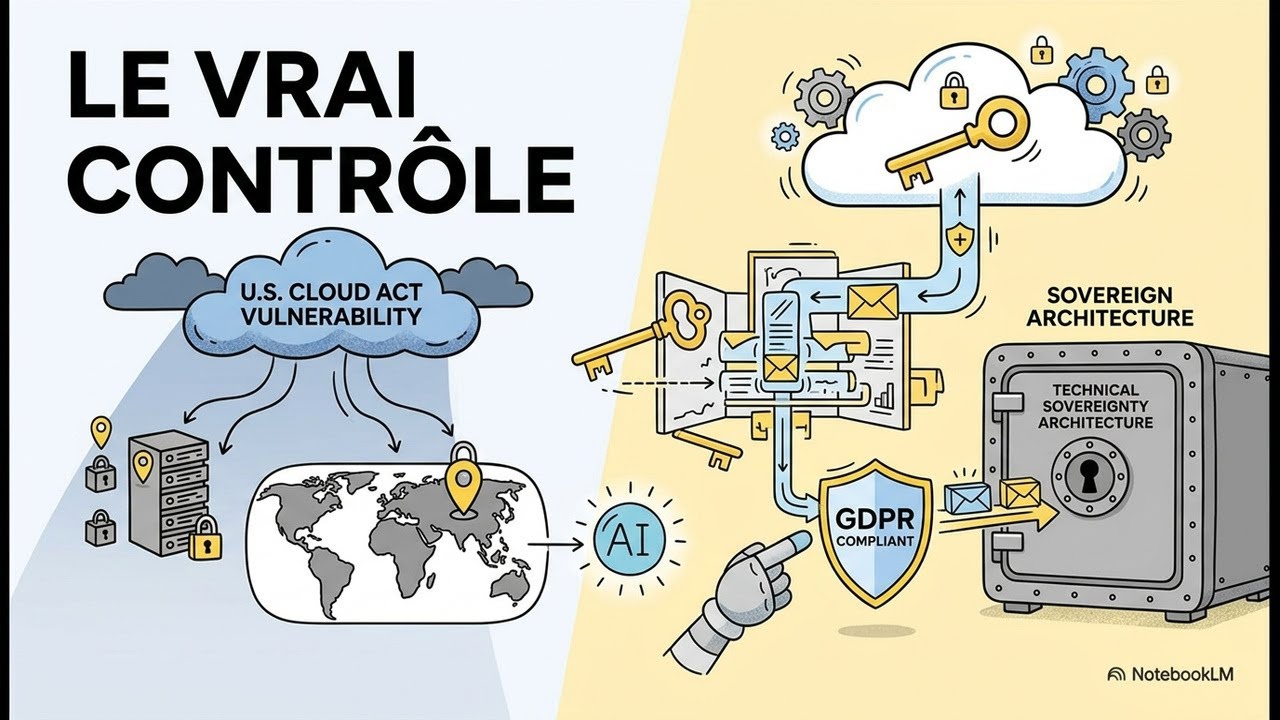
Digital sovereignty has shifted from a geographical question to a technological and architectural one. The U.S. CLOUD Act enables American authorities to access data stored anywhere globally, rendering physical location irrelevant. European and French responses—anchored in GDPR compliance and national security frameworks—deploy alternative strategies: trusted cloud certifications (SecNumCloud), cross-border joint ventures (Bleu), and security standards (BSI C5). These initiatives do not reject U.S. cloud providers outright but establish governance layers, encryption protocols, and sovereignty controls that structurally prevent unauthorized disclosure. The operational implication is clear: organizations must adopt cloud architectures with explicit data residency enforcement, cryptographic isolation, and compliance-by-design rather than relying on contractual guarantees alone.
Key Points
CLOUD Act establishes extraterritorial reach: U.S. legislation permits federal authorities to compel U.S.-based service providers to disclose customer data regardless of physical storage location, directly conflicting with GDPR’s territorial data protection model and creating compliance dilemmas for European enterprises.
SecNumCloud 3.2 qualification enforces architectural sovereignty: ANSSI’s framework mandates strict access controls, encryption key management, and audit trails, ensuring sensitive data (defense, healthcare, finance) remains operationally isolated from foreign legal frameworks through technical controls rather than contractual limitations.
Bleu joint venture (Orange-Capgemini) integrates Microsoft 365 within sovereign infrastructure: Combines commercial cloud productivity with French-hosted data processing, leveraging trusted compute environments to deliver enterprise applications while maintaining compliance posture and reducing extraterritorial risk exposure.
BSI C5 (German standard) extends sovereignty beyond borders: Cross-industry framework establishes consistent security baselines across European cloud providers, creating interoperable compliance mechanisms that reduce vendor lock-in and strengthen regional data protection independence.
Encryption and confidential computing shift control boundaries: Modern approaches employ customer-managed encryption keys, homomorphic encryption, and trusted execution environments to mathematically prevent service providers—regardless of jurisdiction—from accessing plaintext data without explicit cryptographic authorization.
Limitation: No perfect immunity from legal coercion: Even with these controls, organizations remain vulnerable if encryption keys, administrative credentials, or source code are stored within U.S. jurisdiction; sovereignty is relative, not absolute, requiring continuous monitoring of supply chain dependencies.
Operational governance becomes critical: The “how” question demands organizational maturity—data classification policies, key escrow procedures, incident response protocols for cross-border disclosure requests, and transparent logging—transforming sovereignty from compliance checkbox to continuous operational discipline.
References (Golden Sources)
Sources :
- CCBE Assessment of the U.S. CLOUD Act
- CLOUD Act vs. GDPR: The Conflict About Data Access Explained – Exoscale
- Bleu: A Strategic Alliance for Digital Workplace Sovereignty – Jint
- BSI C5: Establishing itself as a cross-industry standard for cloud security – Röd & Partner
- A practical guide to cloud security labels - The trusted cloud – Cloud Temple
- Confidential Computing and Privacy – Future of Privacy Forum
Wet & Sea Tech Resources
YouTube (@wetseatech) : https://www.youtube.com/@wetseatech
Shop : https://wetseatech.etsy.com
More articles — Prospective : https://wetandseaai.pascal-froment.workers.dev/tags/prospective/