Contexte
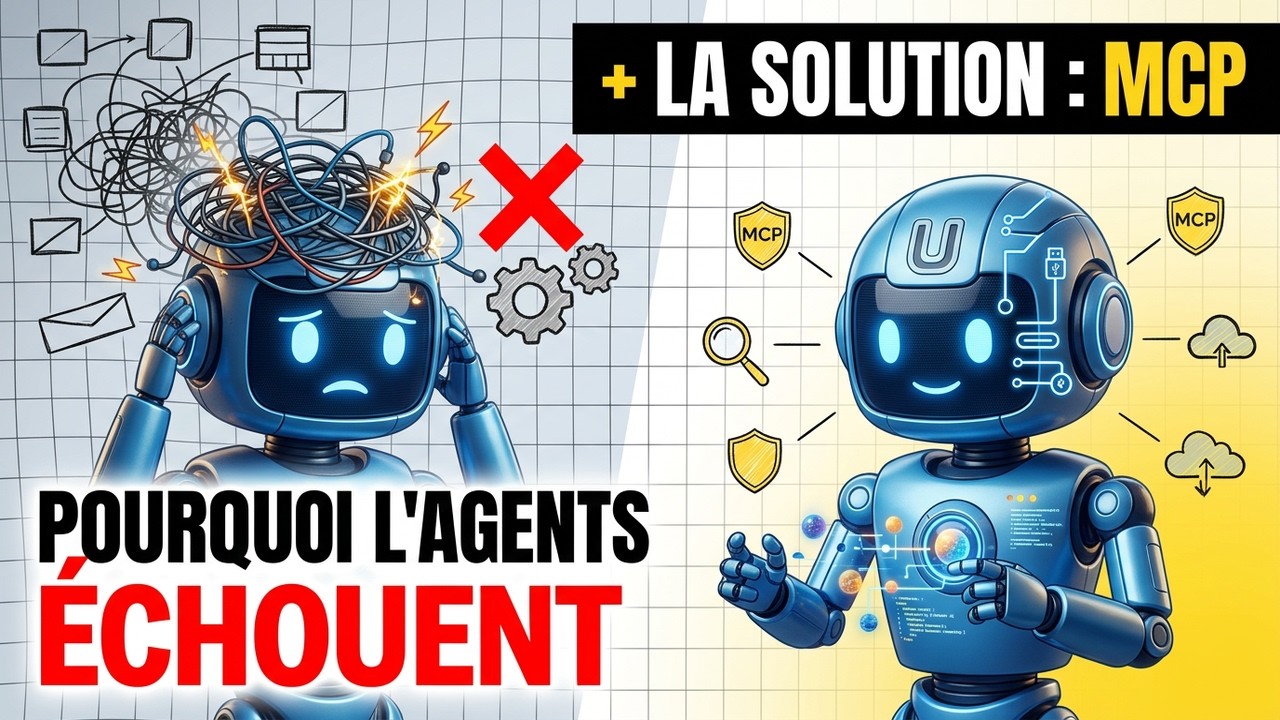
These sources explore the technical evolution of intelligent AI agents, focusing on how Context Engineering transforms them from simple chatbots into autonomous collaborators. While traditional chatbots are often limited to single responses, stateful agents utilize Sessions to track immediate dialogue and Memory to persist user preferences across multiple interactions. Developers use strategies like recursive summarization and compaction to manage data limits and reduce costs within the model’s context window. The documentation also highlights the Model Context Protocol (MCP), which standardizes how these systems securely integrate with external tools and data sources. By intelligently extracting and consolidating information, these frameworks enable AI to reason, plan, and execute complex workflows with a personalized understanding of the user.
Chapitres
0:00— Introduction0:38— Chatbot vs Agent IA1:17— Le Tool Gap1:54— Problème d’intégration M x N2:35— Explosion des connexions
Sources
- A Guide to AI Agent Evaluation and Observability - Towards AI
- AI Integration Architecture: The Control Layer Separating CX Leaders
- Build and manage multi-system agents with Vertex AI | Google Cloud Blog
- Context Engineering: Sessions, Memory
- Create multi agent system with ADK, deploy in Agent Engine and get started with A2A protocol | Google Codelabs
- Deploy to Vertex AI Agent Engine - Agent Development Kit (ADK) - Google
- Evaluation-Driven Development and Operations of LLM Agents: A Process Model and Reference Architecture - arXiv.org
- Everything is Context: Agentic File System Abstraction for Context Engineering - arXiv
- Google Developers news and updates | Google Blog
- Guide - Model Context Protocol (MCP)
- Introduction to Agents - Rivista AI
- LLM-as-a-Judge: How to Build Reliable, Scalable Evaluation for LLM Apps and Agents
- MCP Docs - Model Context Protocol (MCP)
- Memory as Action: Autonomous Context Curation for Long-Horizon Agentic Tasks - Rivista AI
- Model Context Protocol